Welcome to MappaMundi
A D&D setting that takes the premise that the weird, medieval maps were actually completely accurate and beyond that point there really do be dragons!
This world was originally homebrewed in 2011 for a 4e campaign, developed for 5e campaigns, and is now serving multiple campaigns using the BECMI rules from the 1990 Rules Cyclopedia.

Premise of the Setting
This setting assumes the premise that the dark ages on which most fantasy settings are based were brought on not by the mere collapse of the Roman Empire but by the temporary collapse of the barrier between the Material Plane, the Feywild, and the Shadowfell. Throughout the world, shards of these rifts persist -- in some places wider than others.
These facts have been shrouded in legend and time; it is unusual for an inhabitant of the world to know of these events with this degree of specificity and accuracy. They are presented here in accordance with the conventional wisdoms of a number of cultures. Characters are likely to have their own understanding of history, and those they meet will have individual views of varying accuracy, myth, and superstition.


The Magiclysm
Commonly known throughout Europe as “The Magiclysm,” this event has shaped the known world more than any other before or since. The world after this time was fundamentally different – even physically different – than it had been before.
The precise chronology of events is no longer known, but some conflicting eyewitness accounts are known to exist, such as this one:
In primo gradu tribulatione caelum laceratus electricitatis. Terra mota. Tenebrae factae sunt in terra. Theodosius legiones duxit sibi pro Constantinopolitano inutiliter. Catervam Draconigenae prostravit et Urbe. Intra quinquennium Imperium esse desierit.
“In the first stage of the tribulation, the sky was torn with energy. The Earth shook. Darkness came over the land. Theodosius himself led legions in defense of Constantinople to no avail. The horde of dragonborn were too much, and the city fell. Within five years, the Empire was no more.” -Diogenes of Heraclea, circa AD 383

After the Magiclysm
In the ensuing centuries, the creatures which poured forth from the Feywild and Shadowfell rifts began to displace humanity (entirely in some places), and the social fabric broke down. Thousands of petty wars raged across the face of the Earth as the newcomers found habitable zones as close as possible to those in which they lived on the other side of their rifts. Thus, dwarves came to control cold, rocky places, while dragonborn favored warmer climes.
Some of the newcomers were completely uncivilized (like kobolds and goblins), while others were literally animals (such as monsters). Several races distinguished themselves, however, in being at least as civilized as the humans – dwarves, elves, halflings, and dragonborn. Some of the races were largely peaceful and found habitation alongside existing human communities (like the halflings and gnomes) and some were warlike, conquering and enslaving human kingdoms to build great empires (like the dragonborn).
Contention between humans and dwarves during the dwarven conquest of Scandinavia was particularly fierce, although it settled into a stable peace after the human populations migrated or accepted rule from under dwarven mountains. In areas where the dwarves had less human competition for the land, the transition was more peaceful.
Wé Hamer-Dwærfa in geár-dagum þéod-cyninga þrym gefrúnon, hú ðá æþelingas ellen fremedon. Oft Hádor Fyrening sceaþeana þréatum, monegum mægþum meodo-setla oftéah; egsode ús, syþþan ærest wearð féasceaft funden; hé þæs frófre gebád: wéox under wolcnum, weorð-myndum þáh, oðþæt him æghwylc þára ymb-sittendra ofer hron-ráde hýran scolde, gomban gyldan: þæt wæs heaðo-grim dwærf!
“The Hammer-Dwarves in days gone by, and the kings who ruled them, had courage and greatness. We have heard of those princes’ heroic campaigns. There was Hador Fireson, scourge of many tribes, a wrecker of mead-benches, rampaging among us. This terror of the hall-troops had come far. A foundling to start with, he would flourish later on as his powers waxed and his worth was proved. In the end, each clan on the outlying coasts beyond the whale-road had to yield to him and begin to pay tribute. That was one fierce dwarf!” –attributed to Eadgyð Ericsdottir, Saxon noblewoman, date unknown

The Arkhosian Period
After toppling the Roman Empire, which by that time had taken up an eastern capital at Constantinople, the dragonborn subjugated humanity and established a great empire encompassing North Africa, the Middle East, and Central Asia. This empire, known as Arkhosia, lasted five centuries before it began to encroach on Europe, which was by then home to several stable human kingdoms, as well as dwarves, elves, halflings, gnomes, and one large tiefling empire.
Arkhosia was apparently an attempt to recapture the glory of a mighty dragonborn empire by the same name which existed on the other side of the rift prior to the Magiclysm.
Relations between dragonborn and humanity were characterized by antagonism and brutality.
هنگامی که خزندگان خراسان را تصرف کردند، مردان توانمند را به بردگی گرفتند تا در ساختن شهری بزرگ کار کنند. زنان و کودکان را ذبح کردند و گوشت آنها را به بردگان دادند.
“When the reptiles captured Khurasan, they enslaved the able-bodied men to work on building a great city. The women and children they slaughtered over time and fed their flesh to the working slaves.” –Jalal Aghassi, Persian historian, circa AD 577
The Rise & Fall of the Tieflings
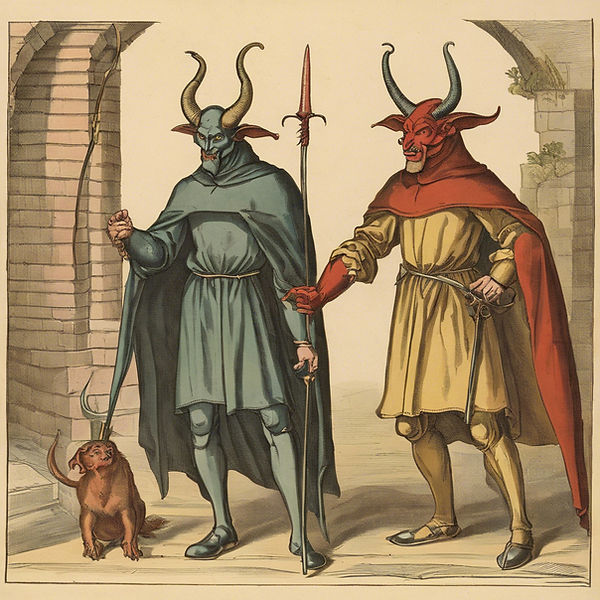
In response to the early days of the Magiclysm, a human warlord named Bael Turath (who some argue had been a Roman centurion, although historians remain divided on this point) thought it would be best to make a pact with some of the dark powers from the Shadowfell in order to defend humanity. This caused a spiritual and physical corruption of the nobles and clerics who joined the pact. All the human inhabitants of the Bael Turath Empire thus became the first tieflings.
The Empire of Bael Turath came to encompass much of Central and Eastern Europe. It exerted its influence throughout Europe, as many small kingdoms became vassal states or otherwise pledged their allegiance to Bael Turath for protection.
The Empire was successful at keeping the dragonborn at bay through a state of near-constant warfare, but the repercussions of the dark pact were increasingly felt. As Arkhosian forces seemed poised to break through the Bael Turath lines at the Battle of Edirne (paving the way for a full invasion of Europe) a tiefling priest escalated the pact. No one is quite sure how or with what terms, but the results were catastrophic.
In what seemed an instant, both empires were utterly destroyed by magic forces. Vast swaths of land were laid waste and both Arkhosia and Bael Turath ceased to exist as further chaos and dark magic were unleashed upon the Earth.
Într-o clipă, un pumn închis distrus Pamantul, spargere oraşe şi măcinare armatele în praf.
“In an instant, a dark fist smashed the Earth, shattering cities and grinding armies into the dust.” –Radu cel Bun, surviving tiefling general after the Battle of Edirne, 14 October 1066
The dragonborn cities were ground to dust, and their ruins extend throughout their old empire to this day. The Bael Turath cities were also left in ruins, and their lands and inhabitants became cursed.
Many dragonborn and tieflings survived (but most of those races were annihilated). The surviving dragonborn returned to their homes to find their cities destroyed and most of their populations dead. With broken spirits, the dragonborn took to a nomadic life, continuing to live among the ruins of their former empire, but not rebuilding it. They set their human slaves free, and, despite years of violence, the newly-freed nomadic peoples taught their dragonborn former masters how to live an unsettled existence in harsh desert climates of Earth. Consequently, the nomadic human tribes now live in peace with the nomadic dragonborn.
The tieflings were another matter. When their survivors returned to Bael Turath, they found their cities similarly destroyed, but the populations had not been killed...at least not exactly. They became a vast horde of undead. Tieflings today live in small, semi-nomadic communities on the edges of human civilization (much like the Romani people in our own world), and the region of Bael Turath (now known as “The Cursed Wastes”) contain shattered cities peopled by armies of undead beings of all kinds and levels of intellect and power.
The Campaign World
The campaign opens in the year 1366, three centuries after the Battle of Edirne. In the power vacuum left by the simultaneous destruction of the Arkhosian and Bael Turath Empires a combination of the decline of social order and newly empowered darkness have led to 300 years of disorder and warfare.
As civilization began to reemerge, small kingdoms and city states were established. They represented small “points of light” in the darkness and the chaos they punctuated. Most of the world, including most of Europe, was a wild and lawless place at the mercy of monsters and barbarians. Now that a new order has become relatively stable, the civilized races (humans, dwarves, elves, halflings, tieflings and dragonborn) all live in relative peace and cooperation against the raging barbarism (although some of their states and settlements do come into conflict with each other from time to time, most notably the humans and dragonborn).
Although the glory of Arkhosia is gone, and its cities lie in ruins, a number of successor states have emerged. The first of these was Khosi, on the Iberian peninsula. After Khosi was overthrown, the dragonborn retreated south and formed the kingdom of Granada. Other such states are Carthage, Tripolitania, Egypt, and Mesopotamia. In much of North Africa, the Sahara, and Arabia, dragonborn tribes live a nomadic and fiercely independent existence. Relations between the new dragonborn states and the human states have been once again growing tense.
The Known World

Download Full-Size Regional Maps